

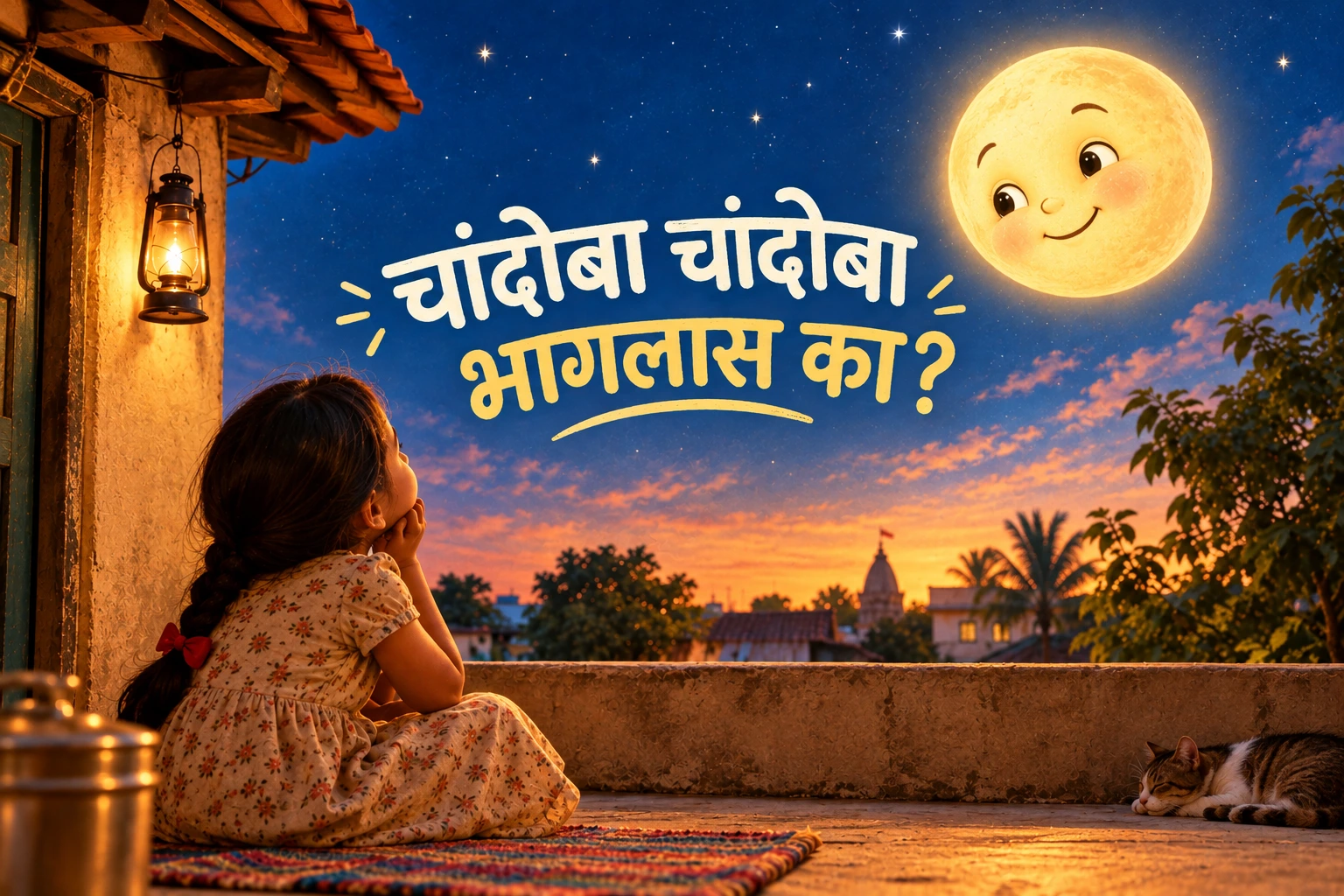
“चांदोबा चांदोबा” is one of the best-loved traditional Marathi balgeet (children’s rhymes), a lullaby in which a child calls out to the moon, affectionately nicknamed “Chandoba” (“Uncle Moon”), asking why it has hidden away and coaxing it to come back out. Generations of Marathi households have sung this rhyme to children at bedtime, and it remains a staple of Marathi baalgeete even today. Below you’ll find the original Marathi lyrics, a Romanized version for readers who speak Marathi but read it more easily in English letters, and a simple English explanation of what each stanza means.
चांदोबा चांदोबा: Marathi Lyrics (Devanagari)
चांदोबा चांदोबा भागलास का?
निंबोणीच्या झाडामागे लपलास का?
निंबोणीचे झाड करवंदी मामाचा वाडा चिरेबंदी
आई-बाबांवर रुसलास का?
असाच एकटा बसलास का?
आता तरी परतुनी जाशील का?
दूध अन् शेवया खाशील का?
आई बिचारी रडत बसेल बाबांचा पारा चढत असेल असाच बसून राहशील का?
बाबांची बोलणी खाशील का?
चांदोबा चांदोबा कुठे रे गेलास?
दिसता दिसता गडप झालास! हाकेला ‘ओ’ माझ्या देशील का? पुन्हा कधी आम्हाला दिसशील का?
Chandoba Chandoba: Romanized Lyrics
Chandoba chandoba bhaglas ka?
Nimbonichya zhadamage laplas ka?
Nimboniche zhad karavandi Mamacha wada chirebandi
Aai-babanvar ruslas ka?
Asach ekata baslas ka?
Aata tari paratuni jashil ka?
Doodh an shevaya khashil ka?
Aai bichari radat basel
Babancha para chadhat asel Asach basun rahashil ka?
Babanchi bolani khashil ka?
Chandoba chandoba kuthe re gelas?
Dista dista gadap zhalas! Hakela ‘o’ majhya deshil ka?
Punha kadhi aamhala disashil ka?
Chandoba Chandoba: Meaning in English
Stanza 1: The child calls out to the moon, asking if it has run off and hidden behind the neem tree. The last two lines paint a picture of the scene: the neem tree bordered by karvand (a wild berry bush), near a maternal uncle’s sturdy, stone-walled house, a common image of a respectable, well-built home in old Marathi villages.
Stanza 2: The child asks whether the moon is sulking with its own parents and sitting off alone because of it, then gently coaxes it: won’t it come back now, and won’t it eat milk and shevaya (sweet vermicelli) if it does? It’s the same way a parent might tempt a sulking child home with a favourite treat.
Stanza 3: The child imagines what’s happening at home while the moon hides: its mother sitting and crying with worry, its father’s temper rising. It asks if the moon really means to just keep sitting there, and whether it’s ready to face a scolding from its father over it.
Stanza 4: In the final stanza, the child calls out again, puzzled that the moon, visible only a moment ago, has suddenly vanished (behind the clouds, most likely). It asks the moon to answer back with an “O” to its call, and wonders, a little wistfully, whether it will ever get to see the moon again.
I hope you found this helpful! Let me know your favourite marathi lullaby’s in the comments below. You can watch the video here
Next song that you can sing – येरे येरे पावसा (Yere Yere Pavsa)

मराठी
नमस्कार, मी गायत्री.
मुंबईत वाढले. आजीच्या गोष्टी ऐकत, आईने शिकवलेल्या म्हणी बोलत, घरच्या सणांच्या गडबडीत. तेव्हा कधी वाटलंच नाही की हे सगळं खास आहे.
माझी मुलगी झाली, आणि एक दिवस मनात आलं: हे सगळं तिच्यापर्यंत कसं पोहोचणार?
त्याच प्रश्नातून आपला मराठी माणूस सुरू झालं. मराठी संस्कृती फक्त आपल्यापुरती राहू नये, ती सर्वांची व्हावी. म्हणून मी मराठीत, रोमन लिपीत आणि इंग्रजीत लिहिते, जेणेकरून कोणीही मागे राहू नये.
इथे जे लिहिते, ते मी जगलेलं, ऐकलेलं आणि मोठ्यांकडून शिकलेलं आहे.
Romanized
Namaskar, mi Gayatri.
Mumbait vaadhle. Aajichya goshti aikat, aaine shikavlelya mhani bolat, gharchya sananchya gadbadit. Tevha kadhi vatlach nahi ki he sagla khaas aahe.
Majhi mulgi zali, ani ek divas manaat aala: he sagla tichyaparyant kasa pohochnar?
Tyach prashnatun Aapla Marathi Manoos suru zala. Marathi sanskruti fakta aaplyapurti rahu naye, ti sarvanchi vhavi. Mhanun mi Marathit, Roman lipit ani Engrajit lihite, jenekarun konihi maage rahu naye.
Ithe je lihite, te mi jagalela, aikalela ani mothyankadun shiklela aahe.
English
Namaskar, I’m Gayatri.
I grew up in Mumbai listening to my grandmother’s stories, repeating the proverbs my mother taught me, and getting lost in the bustle of festivals at home. Back then, I never realised how special it all was.
Then my daughter was born, and one day a thought stayed with me: how will all of this reach her?
Aapla Marathi Manoos began with that question. I don’t want Marathi culture to stay only with us; I want it to belong to everyone. So I write in Marathi, in Romanized Marathi, and in English, so that no one is left out.
Everything here is something I’ve lived, heard, or learned from my elders.