

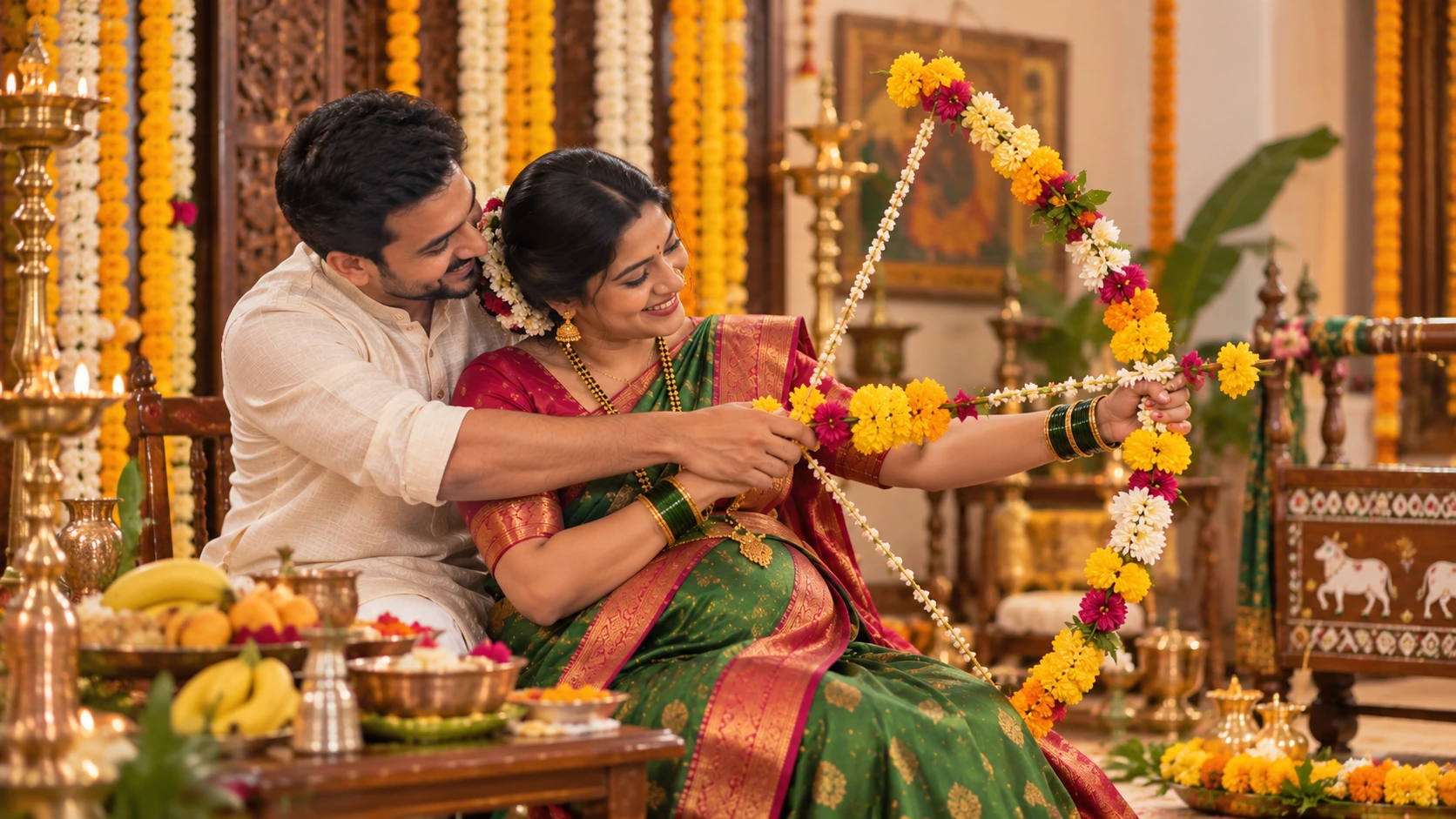
Ask any Marathi aaji what a baby shower should look like and she will not describe balloons or a cake. She will describe a mother-to-be in a green saree, decked in jewellery made of fresh flowers, sitting on a swing while the women of the house fill her lap with rice, coconut and blessings. That scene is Dohale Jevan (डोहाळे जेवण), and its heart is a ritual called Oti Bharan (ओटी भरण).
This guide explains what both terms mean, when the ceremony is held, how each ritual is performed, what is served, and how Maharashtrian families are celebrating it today.
What do Dohale Jevan and Oti Bharan mean?
Dohale (डोहाळे) is the Marathi word for the cravings and fancies of pregnancy, and jevan (जेवण) means a meal. So Dohale Jevan is, quite literally, a feast that satisfies the mother-to-be’s cravings. It is Maharashtra’s version of a custom found across India, known as Godh Bharai in the north, Seemantham in the south, Valaikappu in Tamil Nadu and Shaadh in Bengal.
Oti (ओटी) refers to the lap, or more precisely the fold of the saree’s pallu held in front of a woman. Bharan (भरण) means filling. In Oti Bharan, married women fill this fold with auspicious items, a gesture that wishes abundance and safety on the mother and the child she carries. A visual archive of a Mumbai Koli ceremony describes the cloth held for this ritual as a symbol of the womb itself.
Where the custom comes from
The ceremony descends from Simantonnayana, one of the sixteen Hindu sanskars (rites of passage), performed in the later months of pregnancy to pray for a safe delivery. Over centuries, the formal Vedic rite softened into the warm, women-led family gathering that Dohale Jevan is today.
Why it matters
- It honours the mother. For one afternoon, every wish of hers is the household’s priority.
- It welcomes the baby into a community. Elders, neighbours and friends all add their blessings.
- It gives emotional support. Late pregnancy can be tiring and anxious; a day of food, songs and laughter lifts her spirits.
- It passes on tradition. Younger women learn the rituals, songs and ukhane by watching and joining in.
When is Dohale Jevan held?
Most Maharashtrian families hold Dohale Jevan in the seventh month of pregnancy, once the first six months are complete. Some prefer the fifth or the ninth month instead. Many families consider odd months auspicious and avoid the eighth month for major rituals.
The exact date is usually chosen with the family priest or by consulting the Marathi panchang for a good muhurta. Practical sense matters just as much: the mother should be comfortable, her doctor should be happy with her health, and it should fall well before her due date.
The ceremony is traditionally hosted at the mother’s maternal home (maher) or her in-laws’ home (sasar), depending on family custom. Many families now hold it at a small hall or on a terrace so more guests can attend.
The rituals of Dohale Jevan, step by step
Customs differ between regions, communities and families, but most Dohale Jevan ceremonies follow a similar flow.
- Getting ready. The mother-to-be wears a new saree, very often a green Paithani or nauvari, along with green glass bangles. Green stands for growth, fertility and new life.
- Phulancha shringar (फुलांचा शृंगार). The signature look of Dohale Jevan is jewellery made entirely of fresh flowers: a tiara or mundavalya, necklace, earrings, armlets, bangles and a waist belt, usually made of mogra, shevanti or rose. Flowers are light and comfortable, and they make the mother look like a goddess of spring.
- The seat of honour. She is seated on a decorated jhopala (swing) or a chair framed with flowers. A crescent-moon backdrop, inspired by the moon swing of folk songs, has become a hugely popular modern touch.
- Puja. A short prayer to Lord Ganesha and the family deity seeks a smooth pregnancy and safe delivery.
- Haldi-kunku and aukshan. Married women (suvasini) apply haldi and kunku to her forehead and perform aukshan, circling a lamp in an aarti plate to ward off the evil eye.
- Oti Bharan. Usually five suvasinis take turns filling her oti. The common items are listed below. Each woman adds her blessing as she places them.
- The barfi-peda game. Two covered plates are placed before her, one holding barfi and one holding peda. Whichever she picks is playfully said to predict a girl (barfi) or a boy (peda). It is pure fun, and the guesses spark plenty of laughter.
- Teer-kaman and other games. Some families add a bow-and-arrow game, chits of suggested baby names, or a guess-the-due-date game.
- Ukhane and songs. The mother-to-be is often asked to take a ukhana, a rhyming couplet that weaves in her husband’s name. Women sing dohale geete, folk songs about the cravings and joys of pregnancy.
- The feast. Finally, she is served a plate of all her favourite foods before the guests eat.
What goes into the oti?
| Item | Marathi name | What it stands for |
|---|---|---|
| Rice | तांदूळ (tandul) | Abundance, prosperity |
| Coconut | नारळ / श्रीफळ (naral) | Purity, a complete and healthy life |
| Blouse piece | खण (khan) | Respect and good wishes for a married woman |
| Haldi and kunku | हळद-कुंकू | Saubhagya (marital good fortune) |
| Betel nut and leaves | सुपारी, विड्याची पाने | Auspiciousness |
| Fruits | फळे | Health and nourishment |
| Flowers and gajra | फुले, गजरा | Joy and beauty |
Some families also add a small coin, dry fruits or sweets. The mother later shares part of the rice and fruit with the family.
Food, attire and gifts
The menu
The golden rule of Dohale Jevan is simple: serve what she craves. Beyond that, families often lay out a classic Maharashtrian spread, such as:
- Sweets: puran poli, shrikhand, basundi, modak or gulab jamun
- Savouries: alu vadi, kothimbir vadi, batata vada
- Mains: masale bhaat, varan-bhaat with tup (ghee), usal, bhaji and poli
- Sides: koshimbir, chutney, papad, kurdai and pickle
The mother’s plate is served first, often on a decorated silver thali, and the women of the family feed her the first bites.
What guests wear
Women usually wear nauvari or Paithani sarees, nath (nose ring) and traditional jewellery; green shades are a popular nod to the theme. Men often choose a kurta with a Nehru jacket or a pheta at more formal ceremonies.
Gifting etiquette
Traditionally, gifts at Dohale Jevan are for the mother: sarees, green bangles, jewellery or things for her comfort. Many families believe baby gifts should wait until after the birth, so baby clothes and toys are usually saved for the Barsa (naming ceremony).
Dohale Jevan today
https://www.instagram.com/p/Cy_D9AcqwYF/?hl=en

Modern Maharashtrian families happily blend old and new. A typical celebration today might pair a traditional Oti Bharan with a themed backdrop, a professional photoshoot, a cake and Western-style games like diaper changing on a doll. Television comedians Sugandha Mishra and Sanket Bhosale, for example, shared photos of a Maharashtrian-style Dohale Jevan that combined Oti Bharan, the barfi-peda ritual, a bow-and-arrow game and cake cutting.
Whatever the style, the essence stays the same: the mother is pampered, and the family gathers to bless the baby on the way.
Tips for planning a comfortable Dohale Jevan
- Keep it short. Two to three hours is plenty for someone in her third trimester.
- Prioritise her comfort. Choose a light saree drape, a cushioned seat with back support and a cool, airy venue.
- Check with her doctor before fasting, travel or any food she is unsure about.
- Plan the oti items in advance so the five suvasinis are ready with their plates.
- Keep the guest list manageable if she tires easily.
Read This Next – Barsa: The Maharashtrian Naming Ceremony
Frequently asked questions
Sources
- Simantonnayana – Wikipedia
- Valaikaapu – Wikipedia
- Performing Oti-bharan ritual – Mumbai Archive Project, Jio Institute
- Godh Bharai: muhurat and regional names – SmartPuja
- Godh Bharai, the Indian baby shower – FirstCry Parenting
- Sugandha Mishra and Sanket Bhosale’s baby shower – SheThePeople

मराठी
नमस्कार, मी गायत्री.
मुंबईत वाढले. आजीच्या गोष्टी ऐकत, आईने शिकवलेल्या म्हणी बोलत, घरच्या सणांच्या गडबडीत. तेव्हा कधी वाटलंच नाही की हे सगळं खास आहे.
माझी मुलगी झाली, आणि एक दिवस मनात आलं: हे सगळं तिच्यापर्यंत कसं पोहोचणार?
त्याच प्रश्नातून आपला मराठी माणूस सुरू झालं. मराठी संस्कृती फक्त आपल्यापुरती राहू नये, ती सर्वांची व्हावी. म्हणून मी मराठीत, रोमन लिपीत आणि इंग्रजीत लिहिते, जेणेकरून कोणीही मागे राहू नये.
इथे जे लिहिते, ते मी जगलेलं, ऐकलेलं आणि मोठ्यांकडून शिकलेलं आहे.
Romanized
Namaskar, mi Gayatri.
Mumbait vaadhle. Aajichya goshti aikat, aaine shikavlelya mhani bolat, gharchya sananchya gadbadit. Tevha kadhi vatlach nahi ki he sagla khaas aahe.
Majhi mulgi zali, ani ek divas manaat aala: he sagla tichyaparyant kasa pohochnar?
Tyach prashnatun Aapla Marathi Manoos suru zala. Marathi sanskruti fakta aaplyapurti rahu naye, ti sarvanchi vhavi. Mhanun mi Marathit, Roman lipit ani Engrajit lihite, jenekarun konihi maage rahu naye.
Ithe je lihite, te mi jagalela, aikalela ani mothyankadun shiklela aahe.
English
Namaskar, I’m Gayatri.
I grew up in Mumbai listening to my grandmother’s stories, repeating the proverbs my mother taught me, and getting lost in the bustle of festivals at home. Back then, I never realised how special it all was.
Then my daughter was born, and one day a thought stayed with me: how will all of this reach her?
Aapla Marathi Manoos began with that question. I don’t want Marathi culture to stay only with us; I want it to belong to everyone. So I write in Marathi, in Romanized Marathi, and in English, so that no one is left out.
Everything here is something I’ve lived, heard, or learned from my elders.