

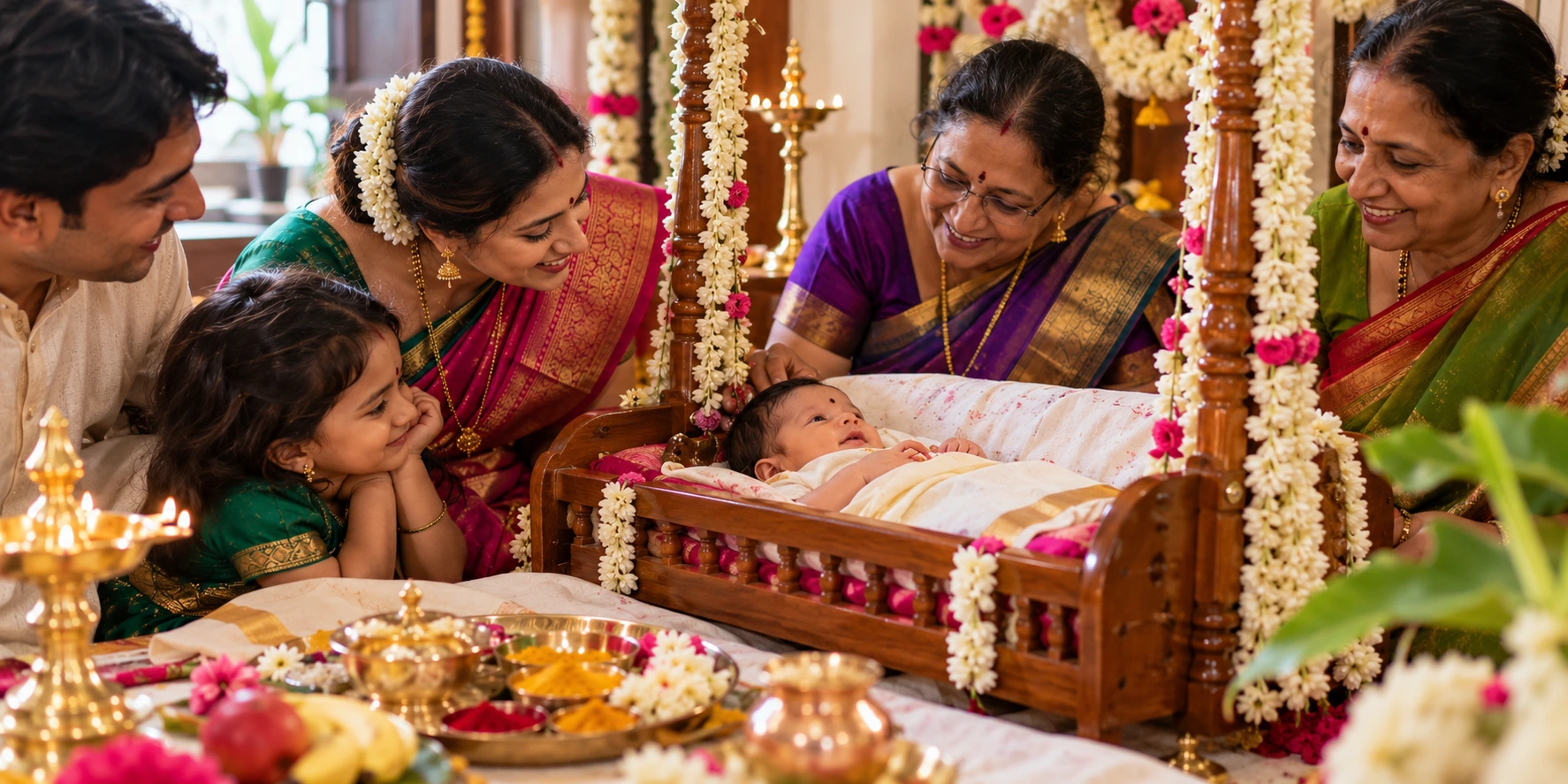
In most Maharashtrian families today, the baby’s name is decided well before the ceremony, often shortlisted during the pregnancy and finalised soon after the birth. Yet families still gather for Barsa (बारसं), the Marathi naming ceremony, to make it official. It is usually held on a convenient weekend a few weeks after the birth, at home or in a small hall, with a decorated cradle, a short puja, a name board for photos, and the atya (father’s sister) announcing the name to the family. For many babies, it is their first big family celebration.
This guide covers what Barsa means, when it is held, the rituals step by step, how the name is chosen, and how families celebrate it today.
What is Barsa?
The word Barsa comes from bara (बारा), meaning twelve, because the ceremony is traditionally held on the twelfth day after birth. It is Maharashtra’s form of Namakaran (नामकरण), one of the sixteen Hindu sanskars, or rites of passage, that mark a person’s life from birth onwards. Similar ceremonies are known as Barasala in Telugu-speaking regions and Naamkaran across north India.
Barsa does two things at once. It formally gives the child a name, and it marks the end of the confinement period after childbirth, when the mother and baby can rejoin family life and welcome visitors.
Why the naming ceremony matters
- A name is an identity. Marathi families, like Indian families in general, attach deep meaning to names. A name is often expected to carry a blessing or a value for the child’s life.
- It welcomes the baby into the family. Relatives meet the newborn, often for the first time.
- It honours the mother. After weeks of rest and recovery, she is celebrated alongside the baby.
- It reminds parents of their role. The blessings spoken at Barsa are a promise to raise the child well.
When is Barsa held?
Traditionally, Barsa falls on the twelfth day after birth. The first days after delivery are treated as a period of rest and ritual seclusion for the mother and baby, and the naming ceremony marks its close. In many Maharashtrian homes, a smaller ritual called Satvai puja or Pachvi-Shashthi is performed earlier, on the fifth or sixth night, to seek the protection of the goddess Satvai for the newborn.
In practice, families are flexible. Some hold Barsa on the 11th or 13th day, and many shift it to a convenient weekend, the 21st day, or after the baby turns one month old. The family priest may suggest a muhurta, while the baby’s health and the mother’s recovery are what matter most.
Barsa is usually held at home, often the mother’s maternal home, where she traditionally stays after delivery.
The rituals of Barsa, step by step
No two families perform Barsa in exactly the same way, but these are the rituals you are most likely to see.
- Cleaning and bathing. The house is cleaned, and the mother and baby are bathed and dressed in new clothes. The baby often gets a fresh dab of kajal and a black thread or bead to ward off the evil eye.
- Decorating the palna. The cradle (पाळणा, palna) is the centrepiece. It is decorated with flowers, mango leaves, balloons or rattles, and marked with haldi-kunku. In some families, a betel nut or a varvanta (the stone roller of a grinding stone) is first placed in the cradle and rocked, as a symbol of strength and stability, before the baby goes in.
- Puja. A short prayer to Lord Ganesha and the family deity blesses the child.
- The baby goes into the cradle. Very often, this is the first time the baby is laid in the palna. Women of the family gather around it.
- Govind ghya, Gopal ghya. In a playful custom, two women pass the baby to each other over and under the cradle. One calls out koni Govind ghya (someone take Govind) and the other answers koni Gopal ghya (someone take Gopal), invoking the child Krishna. Names called out may change for a baby girl and from family to family.
- The atya names the baby. The father’s sister holds the right to announce the name. She whispers it into the baby’s ear, traditionally with a gentle kurr sound, and then says it aloud to the gathering. Some families also write the name on a plate of rice, or on a decorated board.
- Palna geete (cradle songs). Women rock the cradle and sing palna songs and lullabies, blessing the child by name.
- Blessings. Elders apply akshata (rice grains with kunku) on the baby’s head and wish the child a long, healthy and good life.
- Sweets and ghugrya. Batasha (sugar drops) are distributed to guests, along with ghugrya, a mix of boiled whole grains like wheat and chana, which children especially love.
Choosing the name, food and gifts
How Marathi families choose a name
In earlier generations, the expectant mother’s in-laws usually decided the baby’s name. Today, the choice more often rests with the parents, with suggestions from grandparents, relatives and friends. Common approaches include:
- Rashi or nakshatra letter. The family priest reads the baby’s birth chart (janmapatrika) and suggests an auspicious starting syllable.
- Family deity or elders. Names honouring the kuldaivat or a grandparent remain popular.
- Meaning first. Many parents now pick a name for its meaning, sound or uniqueness.
- Two names. Some children receive a formal rashi name and a separate everyday name (bolaycha naav).
Looking for ideas? Browse our collection of Marathi baby girl names & Marathi baby boy names.
The Barsa menu
The food is usually simple and festive: varan-bhaat, a vegetable, puri or poli, and a sweet such as shrikhand, kheer or jalebi, along with the customary ghugrya and batashe. Many families now host a full lunch or dinner. The new mother is often given nourishing postpartum foods like dink ladoo (edible gum laddoo) and methi laddoo during this period.
What to gift at a Barsa
This is the occasion for baby gifts. Popular choices include:
- Silver: a bowl and spoon (vati-chamcha), anklets (vala), bangles (kade) or a waist chain (kardoda)
- Clothes: soft cotton jhablas and swaddles
- Useful items: blankets, a cradle set or toys
- For the mother: the maternal family often gives her a saree
Barsa today
The heart of Barsa has not changed: the cradle, the atya’s whisper and the songs. What has changed is the setting. Families now book small halls, decorate with themed backdrops, reveal the name on a personalised board or cake, and stream the ceremony for relatives abroad. Some families who are not Maharashtrian by origin, but live in Maharashtra, have also adopted the custom.
Tips for a safe, happy Barsa
- Protect the newborn. Keep the guest list small, ask guests to wash or sanitise hands, and avoid passing the baby around too much.
- Keep it short. Newborns tire quickly, and the mother is still recovering.
- Mind the noise and the lights. Skip loud music and camera flashes close to the baby.
- Plan feeding breaks. Give the mother a quiet room to rest and feed.
- Finalise the name spelling before printing boards or invitations, in both Devanagari and English.
Frequently asked questions
Sources
- Barsaa and Maharashtrian childhood rituals – Dr Vidya Yeravdekar, Symbiosis
- Socio-Psychological Aspects and Linguistic Analysis of Marathi Names – Indira Y. Junghare, Names journal
- Barasala – Wikipedia
- Baby naming – Wikipedia
- Music in context: palna and birth songs – Virtual Museum of Images and Sounds (ARCE)

मराठी
नमस्कार, मी गायत्री.
मुंबईत वाढले. आजीच्या गोष्टी ऐकत, आईने शिकवलेल्या म्हणी बोलत, घरच्या सणांच्या गडबडीत. तेव्हा कधी वाटलंच नाही की हे सगळं खास आहे.
माझी मुलगी झाली, आणि एक दिवस मनात आलं: हे सगळं तिच्यापर्यंत कसं पोहोचणार?
त्याच प्रश्नातून आपला मराठी माणूस सुरू झालं. मराठी संस्कृती फक्त आपल्यापुरती राहू नये, ती सर्वांची व्हावी. म्हणून मी मराठीत, रोमन लिपीत आणि इंग्रजीत लिहिते, जेणेकरून कोणीही मागे राहू नये.
इथे जे लिहिते, ते मी जगलेलं, ऐकलेलं आणि मोठ्यांकडून शिकलेलं आहे.
Romanized
Namaskar, mi Gayatri.
Mumbait vaadhle. Aajichya goshti aikat, aaine shikavlelya mhani bolat, gharchya sananchya gadbadit. Tevha kadhi vatlach nahi ki he sagla khaas aahe.
Majhi mulgi zali, ani ek divas manaat aala: he sagla tichyaparyant kasa pohochnar?
Tyach prashnatun Aapla Marathi Manoos suru zala. Marathi sanskruti fakta aaplyapurti rahu naye, ti sarvanchi vhavi. Mhanun mi Marathit, Roman lipit ani Engrajit lihite, jenekarun konihi maage rahu naye.
Ithe je lihite, te mi jagalela, aikalela ani mothyankadun shiklela aahe.
English
Namaskar, I’m Gayatri.
I grew up in Mumbai listening to my grandmother’s stories, repeating the proverbs my mother taught me, and getting lost in the bustle of festivals at home. Back then, I never realised how special it all was.
Then my daughter was born, and one day a thought stayed with me: how will all of this reach her?
Aapla Marathi Manoos began with that question. I don’t want Marathi culture to stay only with us; I want it to belong to everyone. So I write in Marathi, in Romanized Marathi, and in English, so that no one is left out.
Everything here is something I’ve lived, heard, or learned from my elders.