

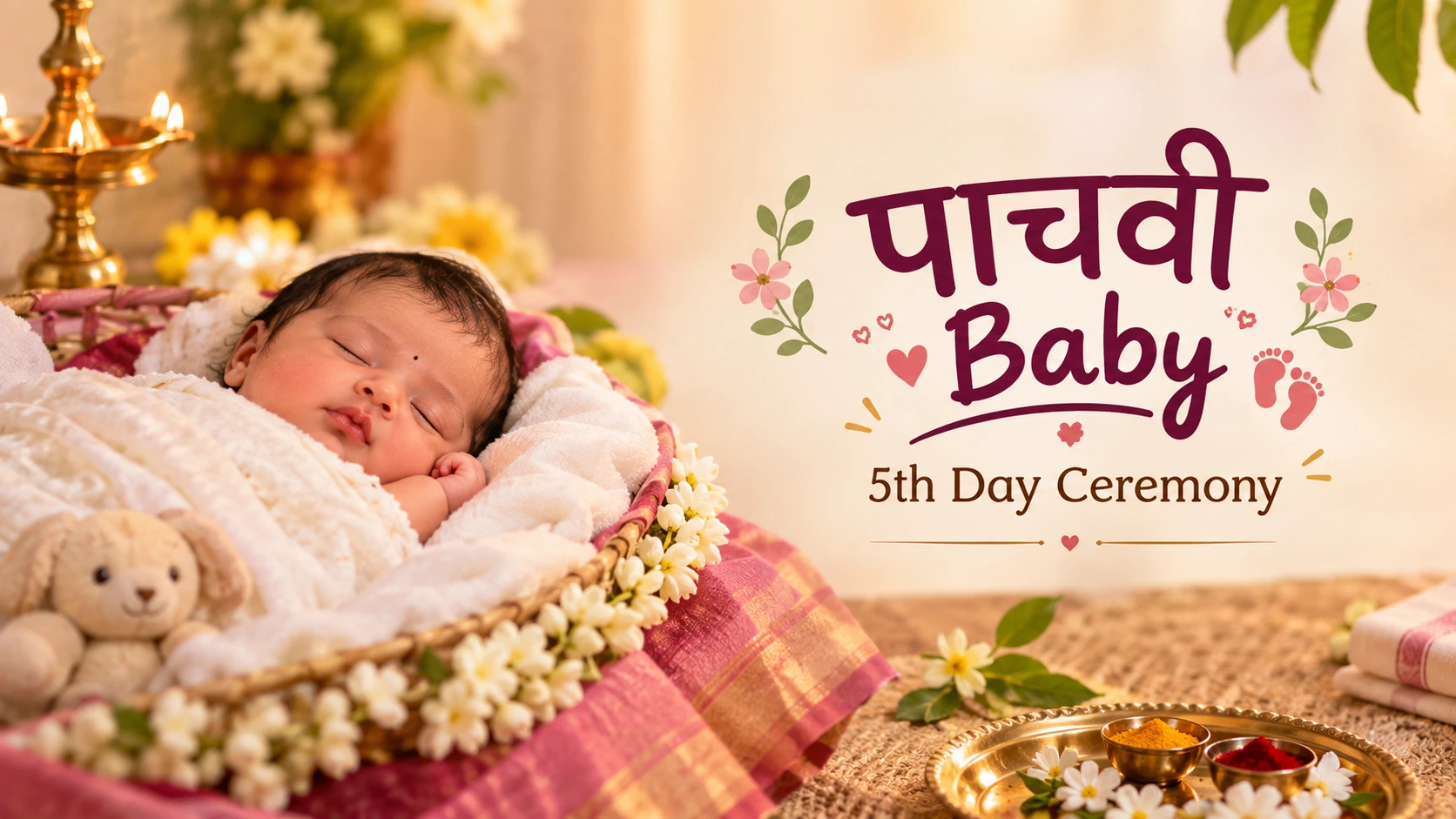
Most people outside Maharashtra have heard of the baby’s naming ceremony, but there’s a smaller, quieter ritual that happens a few days before it, one that doesn’t get talked about as much even though almost every Marathi family knows it. It’s called Paachvi, and it’s built around one of those beliefs that sounds almost like a bedtime story until you realize how seriously families still take it: a goddess comes in the night and writes out the baby’s whole future. This post walks through what Paachvi actually involves, who this goddess is, and why you’ll hear people argue about whether it’s really a fifth-day thing or a sixth-day thing.
What Is Paachvi?
A few days after a baby is born, before the naming ceremony, many Marathi families do a smaller ritual called Paachvi. It happens on the fifth night after birth. At the center of it is a belief that a goddess visits the baby that night and writes down their fate.
In Maharashtra, this goddess is usually called Satwai (sometimes Sataai or Sati). She’s believed to decide things like the child’s health, education, and general luck in life, and she supposedly writes all of it down, on the baby’s forehead or on paper, while the family sleeps.
So Why Do Some People Call It the Sixth Day?
Here’s something that trips a lot of people up, and honestly, it’s worth explaining rather than glossing over. Satwai’s own name comes from the Sanskrit word “sasthi,” which means sixth. Most of the older folklore and research on this goddess talks about the sixth night as the real night she visits, not the fifth.
But if you search for “Paachvi” specifically, you’ll find plenty of Marathi sources describing it as a fifth-day ritual. So what’s going on is that different families do different things. Some do a small Paachvi on day five. Some skip straight to a bigger Satwai puja on day six. And plenty of families just combine the two into one ritual stretched across both nights.
There isn’t one “correct” day. If your family calls it Paachvi and does it on day five, that’s not wrong, it’s just one version of a tradition that’s always varied by region and household.
What Happens on the Night
The exact details change from family to family, but a few things show up again and again:
The house gets cleaned, sometimes with rangoli at the door. The baby is dressed in new clothes. A small plate is set up with turmeric and kumkum, and usually a coconut, some paper, and a pen or pencil, the idea being these are what the goddess needs to write with.
A lamp is kept burning all night. In a lot of households, someone stays up, and there’s singing or storytelling about the goddess. The belief is that the baby shouldn’t be left alone or asleep while she’s supposed to be visiting.
Sweets like kheer and puran poli often get made, and elders bless the baby and the mother. In some families, this is also when the baby’s name gets settled, so it overlaps a bit with the actual naming ceremony (Barsa).
This is traditionally a ritual run by the women of the house and neighborhood, mothers, grandmothers, aunts, though that’s loosened up quite a bit these days.
Down the Coast, It’s a Different Story
Go toward Goa and the same idea shows up with a completely different flavor. There, the sixth-night goddess is called Shashthi, and she comes with her own legend involving a black cat. As the story goes, a daughter-in-law once wrongly blamed the cat for stealing food, and the cat, which belonged to the goddess, started taking away newborn babies in revenge, until the family learned to worship her properly.
Because of that story, part of the Goan ritual involves shaping a little cat out of rice flour and tying it near the baby for protection, along with a fast, a lamp burning through the night, and games or conch-blowing to keep everyone awake.
It’s a good reminder that this isn’t one fixed ritual with one script. It’s a shared idea, a goddess who can help or hurt a newborn in the first days of life, that different communities have shaped into their own version.
Last Word
What’s interesting about Paachvi is that even the confusion around it, is it day five or day six, tells you something true: this has always been a living tradition, passed down through what families actually did, not through a rulebook. Whichever night your family marks it on, the point hasn’t really changed in generations, a family staying up together, watching over a baby who’s barely a week old.
Check Out – 100+ Marathi Baby Girl Names with Meanings
Quick Questions
Is Paachvi the same as Shashthi or Chhathi?
They come from the same root belief, but they’re not identical. Shashthi/Satwai’s name literally means “sixth,” so a lot of the older tradition points to day six. Paachvi is the fifth-day version some families do instead, or alongside it.
What gets offered to the goddess?
Usually coconut, paper, and a pen, plus turmeric, kumkum, and sweets like kheer.
Why does the lamp stay lit all night?
It’s meant to keep the baby watched over while the goddess is believed to be visiting.
Does every family do it the same way?
No, not at all. This is an oral, folk tradition, not something written down in one fixed text, so it changes a lot by region and family.
References
- Dhaara Magazine – “Between Propitiation and Prediction: Satwai, a Folk Deity of the Deccan.” https://dhaaramagazine.in/2024/02/20/between-propitiation-and-prediction-satwai-a-folk-deity-of-the-deccan/
- Talking Myths – “Shashthi and Her Cat.” https://talkingmyths.com/shashthi-and-her-cat/
- Parentune (Marathi) – “बाळाचे पाचवी पूजन: प्रथा, कारणे आणि पारंपारिक महत्त्व.” https://www.parentune.com/mr/parent-blog/new-born-baby-fifth-day-puja-tradition-meaning-ceremony/9698

मराठी
नमस्कार, मी गायत्री.
मुंबईत वाढले. आजीच्या गोष्टी ऐकत, आईने शिकवलेल्या म्हणी बोलत, घरच्या सणांच्या गडबडीत. तेव्हा कधी वाटलंच नाही की हे सगळं खास आहे.
माझी मुलगी झाली, आणि एक दिवस मनात आलं: हे सगळं तिच्यापर्यंत कसं पोहोचणार?
त्याच प्रश्नातून आपला मराठी माणूस सुरू झालं. मराठी संस्कृती फक्त आपल्यापुरती राहू नये, ती सर्वांची व्हावी. म्हणून मी मराठीत, रोमन लिपीत आणि इंग्रजीत लिहिते, जेणेकरून कोणीही मागे राहू नये.
इथे जे लिहिते, ते मी जगलेलं, ऐकलेलं आणि मोठ्यांकडून शिकलेलं आहे.
Romanized
Namaskar, mi Gayatri.
Mumbait vaadhle. Aajichya goshti aikat, aaine shikavlelya mhani bolat, gharchya sananchya gadbadit. Tevha kadhi vatlach nahi ki he sagla khaas aahe.
Majhi mulgi zali, ani ek divas manaat aala: he sagla tichyaparyant kasa pohochnar?
Tyach prashnatun Aapla Marathi Manoos suru zala. Marathi sanskruti fakta aaplyapurti rahu naye, ti sarvanchi vhavi. Mhanun mi Marathit, Roman lipit ani Engrajit lihite, jenekarun konihi maage rahu naye.
Ithe je lihite, te mi jagalela, aikalela ani mothyankadun shiklela aahe.
English
Namaskar, I’m Gayatri.
I grew up in Mumbai listening to my grandmother’s stories, repeating the proverbs my mother taught me, and getting lost in the bustle of festivals at home. Back then, I never realised how special it all was.
Then my daughter was born, and one day a thought stayed with me: how will all of this reach her?
Aapla Marathi Manoos began with that question. I don’t want Marathi culture to stay only with us; I want it to belong to everyone. So I write in Marathi, in Romanized Marathi, and in English, so that no one is left out.
Everything here is something I’ve lived, heard, or learned from my elders.