

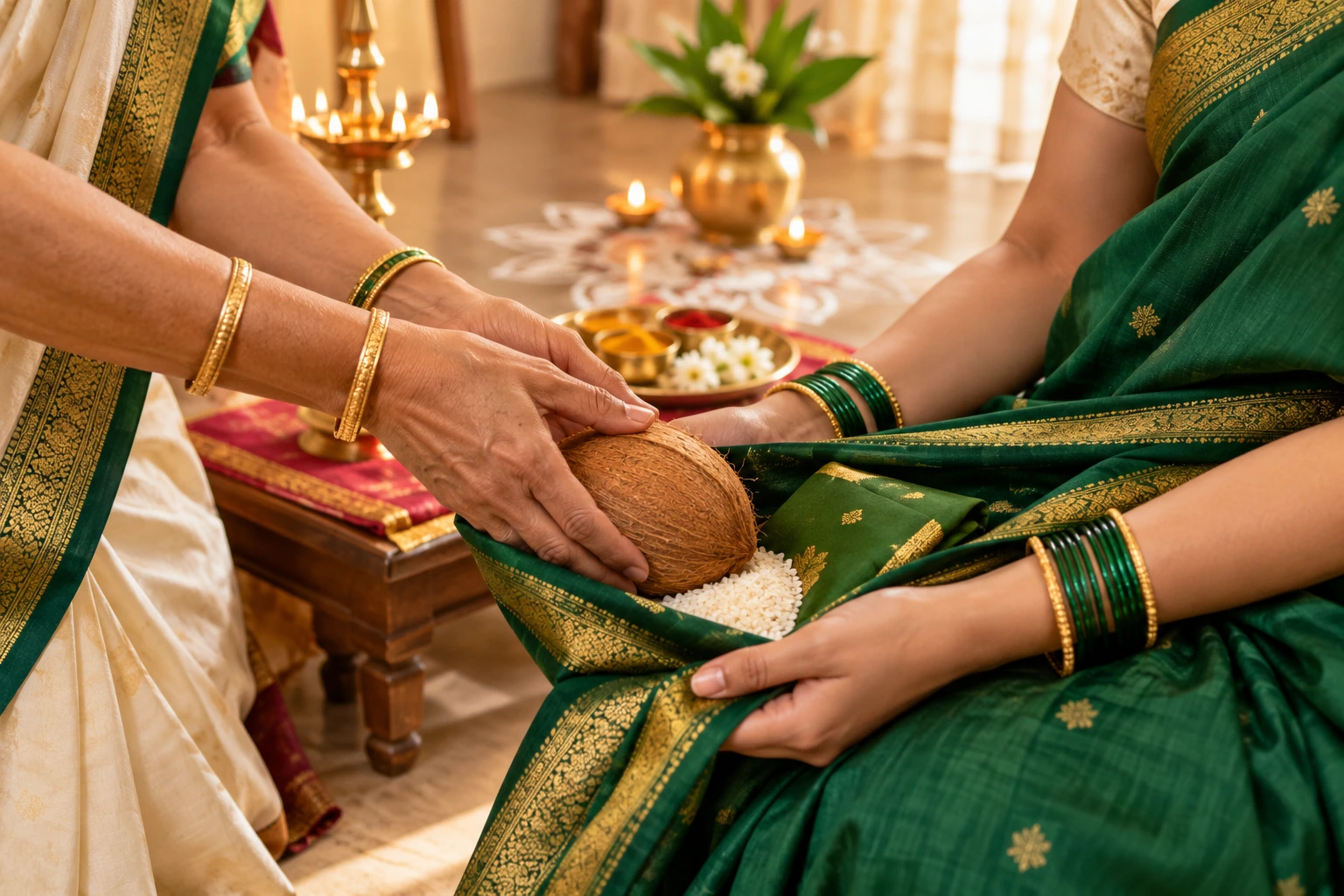
Chor oti (चोर ओटी) is the first, quiet oti-bharan for a pregnant woman in Maharashtrian families. In most homes it is done once the third month of pregnancy is complete. The woman’s maternal family performs it, with only close family present.
When a family learns a baby is on the way, the joy is real. But for the first three months, the news usually stays within the home. Chor oti marks the end of that delicate stretch with a small, loving blessing for the mother-to-be and her baby.
What is chor oti?
The “oti” is the fold of a saree’s pallu held over the lap. Married women fill it with a blouse piece, coconut, rice and fruit. In Marathi culture, filling someone’s oti is a blessing for good fortune, prosperity and motherhood.
“Chor” literally means thief, but here it has nothing to do with stealing. It means quietly, without telling anyone. There are no invitations and no decorations, and the ritual stays inside the home. That is where the name comes from.
In some regions the same custom is called chorcholi (चोरचोळी). The name changes, but the feeling is the same: a first, private blessing for the coming baby.
In which month is chor oti done?
In most Marathi homes, chor oti is done once the third month of pregnancy is complete, at the start of the fourth month.
Why then? The early weeks of pregnancy are seen as the most sensitive, so many families let that time pass quietly. Once the first trimester is safely behind, the worry eases. Chor oti is the first sign of that relief and joy.
The exact timing varies by family and region:
- After the third month is complete: the most common practice.
- In the fourth month: many families hold the chorcholi at the woman’s maternal home in this month.
- In the fifth or sixth month: some families wait longer and do it in the fifth or sixth month. An old Marathi dohale song that describes pregnancy month by month also places chor oti in the sixth month. So the custom has never been tied to one fixed month.
So it is best to ask the elder women in the family before fixing a date. Some families also pick an auspicious day or tithi.
Who performs chor oti, and where?
By tradition, the honour belongs to the woman’s maternal family (maher), and usually her own mother fills the oti. Her daughter is about to become a mother herself, and she blesses both her and the coming baby.
Families follow one of two customs for the place:
- At the maternal home: the daughter comes to her parents’ home for a few days, and the oti is filled there.
- At the in-laws’ home (sasar): in some families, the mother visits her daughter’s marital home to fill the oti.
If the mother cannot be there, an elder married sister, a maternal aunt (mavshi) or another married woman from the maternal side can do it. Only a handful of close family members attend.
Items needed for chor oti
Chor oti is simple, so the list is short. There is no jewellery, no flower decoration and no grand setup.
- Green khan (blouse piece)
- Coconut
- Rice for the oti
- Green glass bangles
- Haldi-kunku
- Green saree (optional, if possible)
- Five kinds of fruit (in some families; no bananas)
- Panchamrut: curd, milk, ghee, honey and sugar (in some families)
- A low wooden seat (paat or chaurang), rangoli and a niranjan
The green khan has a second life. Many families keep it safely, and after the baby is born they stitch the baby’s first cap (topde) or hooded wrap (kunchi) from it. The fabric travels from the mother’s oti to the baby’s first clothes.
How is chor oti done?
The chor oti ritual is short, simple and homely, and takes about 15–20 minutes. Details vary from home to home, but the usual order is:
- Pick the time: early morning, ideally before any outsiders visit. In older times it was finished at dawn.
- Prepare the spot: draw a rangoli in front of the home shrine or in a clean corner, and place a paat or chaurang on it.
- Offer prayers: the mother-to-be bows to the family deity, and a niranjan is lit.
- Seat the mother-to-be: let her sit comfortably on the paat, with back support if possible.
- Haldi-kunku: her mother, or a married woman from the maternal side, applies haldi-kunku to her.
- Fill the oti: the green khan, coconut and rice (and fruit, if that is the family custom) go into her saree pallu. Green bangles are put on her wrists.
- Something sweet: she is fed panchamrut, or rice mixed with curd and milk.
- Blessings: the elders bless mother and baby for a safe delivery.
One older custom is especially memorable. Small clay pots of milk and curd hung from the ceiling in a shinkala (rope sling), and the mother-to-be sat beneath it while her oti was filled. In some families, she was then given a little panchamrut every day for a while.
Why are bananas not put in the oti? Other beliefs
Whether at chor oti or dohale jevan, families avoid placing bananas in a pregnant woman’s oti. A banana plant is believed to bear fruit only once before it dies. From this came the folk belief that bananas in the oti would mean no more children in future.
A few other beliefs linked to chor oti:
- Keeping it quiet: the good news stays within the family for the first three months.
- Next oti only at dohale jevan: in many homes, after chor oti, the next oti is filled only on the day of dohale jevan.
- The colour green: the green khan and green bangles stand for prosperity and new life.
These beliefs are part of faith and tradition. Each family can decide how closely to follow them.
Chor oti vs dohale jevan: what’s the difference?
Chor oti is a private first blessing. Dohale jevan is the big, joyful Maharashtrian baby shower with relatives and friends.
| Point | Chor oti | Dohale jevan |
|---|---|---|
| Month | Usually after the 3rd month is complete | Usually the 7th or 9th month |
| Who attends | Only close family at home | Both families, relatives, friends |
| Who fills the oti | Maternal family, mainly the mother | Married women from both families |
| Celebration | None; no jewellery or decoration | Flower jewellery, swing, decoration, songs |
| Food | Panchamrut or curd-milk-rice | All of the mother-to-be’s favourite dishes |
| Purpose | First blessing after the delicate early phase | Fulfil her cravings (dohale), celebrate |
Chor oti today: things to keep in mind
The best approach today is to keep the heart of the tradition while putting the mother-to-be’s comfort first.
- Her comfort comes first: if she feels tired or nauseous, keep the ritual very short. Give her a cushion and back support.
- Check with the doctor: before giving panchamrut or any special food, ask the doctor, especially if she has diabetes or other concerns.
- Families living apart: if the mother cannot travel, a married woman at home can fill the oti, and the mother can bless her over a video call.
- Social media: the whole point of chor oti is quietness. Whether to share photos is for the parents-to-be to decide.
- Agree on customs early: the two families may differ on the month, day or items. Talk it through beforehand.
Read in Marathi – चोर ओटी कधी आणि कशी भरतात? संपूर्ण विधी, साहित्य आणि महत्त्व
Frequently asked questions
References
This article was written in our own words after studying the sources below. Customs vary from family to family; when in doubt, ask the elders at home.
- Pooja Karande-Kadam, “गरोदरपणाच्या कितव्या महिन्यात भरतात चोर ओटी” (In which month of pregnancy is chor oti done), eSakal, 29 February 2024.
- “चोरचोळी” — reader discussion, Maayboli, May 2015.
- “डोहाळे जेवण गाणी” (Dohale jevan songs), Marathi Khabar.

मराठी
नमस्कार, मी गायत्री.
मुंबईत वाढले. आजीच्या गोष्टी ऐकत, आईने शिकवलेल्या म्हणी बोलत, घरच्या सणांच्या गडबडीत. तेव्हा कधी वाटलंच नाही की हे सगळं खास आहे.
माझी मुलगी झाली, आणि एक दिवस मनात आलं: हे सगळं तिच्यापर्यंत कसं पोहोचणार?
त्याच प्रश्नातून आपला मराठी माणूस सुरू झालं. मराठी संस्कृती फक्त आपल्यापुरती राहू नये, ती सर्वांची व्हावी. म्हणून मी मराठीत, रोमन लिपीत आणि इंग्रजीत लिहिते, जेणेकरून कोणीही मागे राहू नये.
इथे जे लिहिते, ते मी जगलेलं, ऐकलेलं आणि मोठ्यांकडून शिकलेलं आहे.
Romanized
Namaskar, mi Gayatri.
Mumbait vaadhle. Aajichya goshti aikat, aaine shikavlelya mhani bolat, gharchya sananchya gadbadit. Tevha kadhi vatlach nahi ki he sagla khaas aahe.
Majhi mulgi zali, ani ek divas manaat aala: he sagla tichyaparyant kasa pohochnar?
Tyach prashnatun Aapla Marathi Manoos suru zala. Marathi sanskruti fakta aaplyapurti rahu naye, ti sarvanchi vhavi. Mhanun mi Marathit, Roman lipit ani Engrajit lihite, jenekarun konihi maage rahu naye.
Ithe je lihite, te mi jagalela, aikalela ani mothyankadun shiklela aahe.
English
Namaskar, I’m Gayatri.
I grew up in Mumbai listening to my grandmother’s stories, repeating the proverbs my mother taught me, and getting lost in the bustle of festivals at home. Back then, I never realised how special it all was.
Then my daughter was born, and one day a thought stayed with me: how will all of this reach her?
Aapla Marathi Manoos began with that question. I don’t want Marathi culture to stay only with us; I want it to belong to everyone. So I write in Marathi, in Romanized Marathi, and in English, so that no one is left out.
Everything here is something I’ve lived, heard, or learned from my elders.